Summary and Response Black Panther
I’ll be honest – I hadn’t watched Black Panther before now. I don’t find superhero movies appealing; and honestly, I don’t watch many movies in general. I am happy this movie exists and I hope that there will be more movies with casts consisting mainly of people from underrepresented groups. However, I don’t feel it is my place to share my personal experience with this movie or how this movie is affecting society – I feel that I need to keep that space open for Black people. With that being said, I would love to see a superhero led by a Native American cast – I’m waiting, Marvel and DC.
To summarize the film: Five African tribes fight over a meteorite containing Vibranium, a highly valuable material. A warrior ingests a “heart-shaped herb,” gains superpowers and becomes the first “Black Panther”. The nation of Wakanda is formed from all but one tribe and Wakandans use the Vibranium to advance their technology while also posing as a Third World country. T’Challa tries to claim the throne after the king dies but Killmonger appears and battles T’Challa for it. In the end, Killmonger dies, T’Challa is king and Wakanda reveals itself as the advanced nation it is to the rest of the world.
Cultural Representation
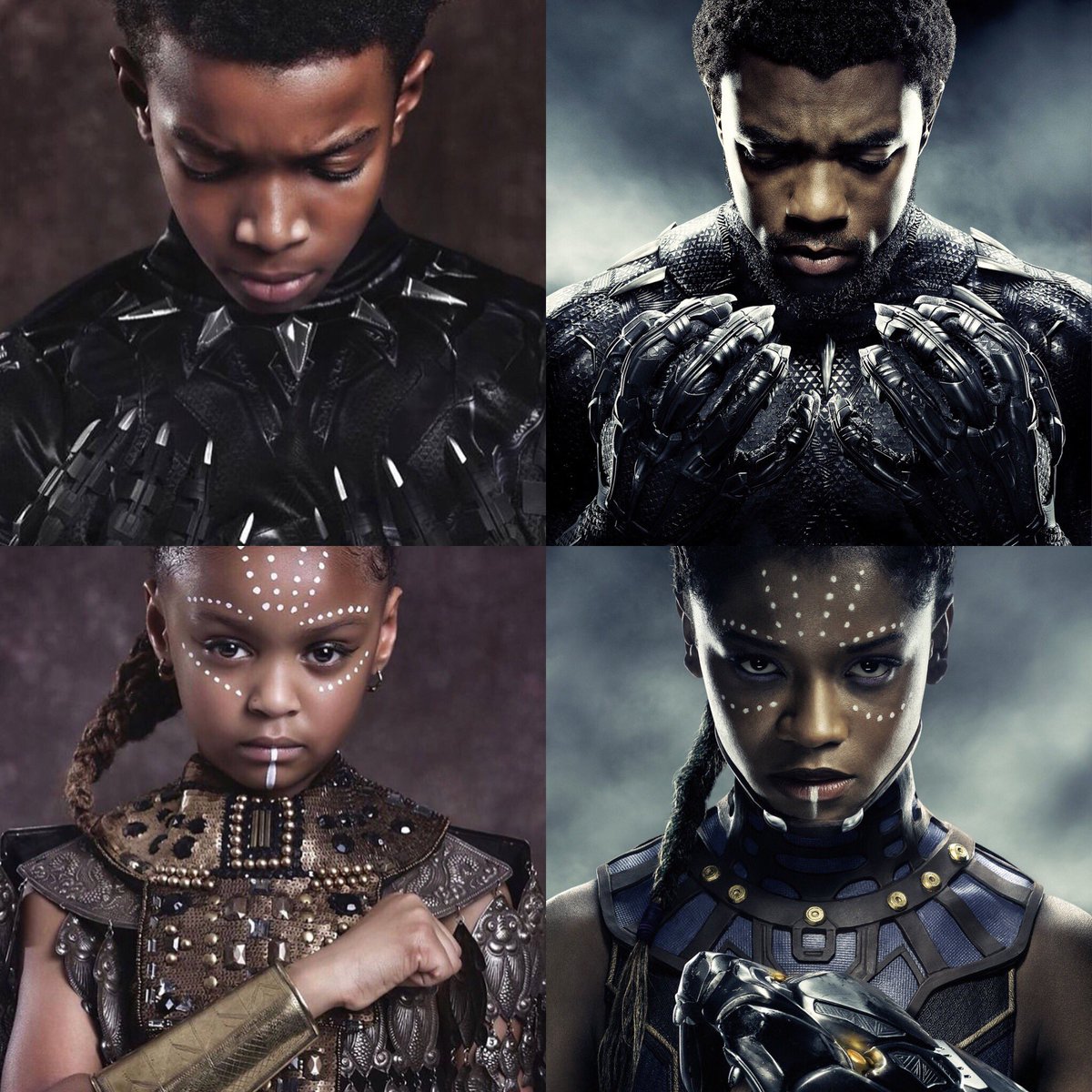
For many Black people, Black Panther is seen as a rare gem of representation among a sea of whiteness. After all, a movie having a majority Black cast is a rare occurrence. Carvell Wallace of the New York Times wrote an article titled “Why ‘Black Panther’ Is a Defining Moment for Black America” and included a quote from Jamie Broadnax, the founder of Black Girl Nerds. Broadnax reaffirms how monumental it is to have a film with a majority Black cast. She is quoted as saying: “It’s the first time in a very long time that we’re seeing a film with centered black people, where we have a lot of agency.” Time Magazine writer Jamil Smith writes in his article “The Revolutionary Power Of Black Panther” that “Making movies about Black lives is part of showing that they matter.” The image I’ve chosen for this blog post is of two young children dressed as characters from Black Panther. In my opinion, this image showcases the impact the film has had on African American youth, giving them more representation and an actual superhero they can look up to.
One of the other reasons the movie earned praise from Black critics is because it showcased Blackness in a fresh light. Wallace also wrote about another quote from Broadnax: “These characters, she notes, ‘are rulers of a kingdom, inventors and creators of advanced technology. We’re not dealing with black pain, and black suffering, and black poverty’ – the usual topics of acclaimed movies about the black experience.”
Christopher Lebron, writer from Boston Review, wrote an article titled “‘Black Panther’ Is Not the Movie We Deserve.” In this article, he expresses that the movie is not extremist enough in its views and does too little too late. “The bad guy is the black American who has rightly identified white supremacy as the reigning threat to black well-being; the bad guy is the one who thinks Wakanda is being selfish in its secret liberation; the bad guy is the one who will no longer stand for patience and moderation—he thinks liberation is many, many decades overdue. And the black hero snuffs him out.” He goes on to say “My president already despises me.” I understand where Lebron is coming from here, but a single movie will not fix the entirety of race issues in the U.S.A. For instance, the 2017 movie Girls Trip is a chick flick comedy that was widely mocked on social media yet was incredibly successful at the box office and has a score of 91% fresh on Rotten Tomatoes. The cause of this? The four main characters are Black women and the movie is about them having a good time together. Does every movie starring a majority Black cast have to be about social justice? In my opinion, no. However, by there being more movies starring a majority Black cast, it is helping level the playing field and increase social justice.
Another idea that was brought up around Black Panther was whether critics of color are being given enough opportunity. Elizabeth Méndez Berry wrote for Hyperallergic an article called “Why Cultural Critics of Color Matter.” Berry writes: “For communities that have been historically shut out of that process, that power is pivotal. It’s the difference between being spoken about and being the authority on your own experience.” This is an extremely important point and what I was touching on in the beginning of this blog post. Make room for the population at hand to speak for themselves instead of being spoken over/for.
 Caitlyn's Blog
Leave a comment