
Similarly to many films I have written about previously, Sleep Dealer is a film I have never seen before. It is an indie futuristic science fiction film released in 2008. The film showcases a dystopian world that takes the idea of “out of sight, out of mind” way too far.

Plot
The main character is a Mexican man named Memo Cruz. Water in his home city used to be free and accessible until a water company came in and began charging resident $1 per gallon. Memo puts together a gadget to listen to people, which ultimately gets his family home targeted with a missile causing his father to die. Feeling guilty, Memo flees to another city and meets Luz, who has data ports on her arms. He talks briefly to her about his background and Luz sells this memory she took of him. Memo looks to have data ports put in his body, which Luz offers to do after Memo was mugged looking elsewhere. Memo begins working as a “sleep dealer” at a virtual sweatshop. This entails workers being connected to cables that control robots that have replaced immigrant workers. Luz gets paid to get more personal information about Memo in the form of another memory. The buyer is revealed to be Rudy, who killed Memo’s father. Luz, Memo, and Rudy sneak into Cybracero and have a drone attack the water company, allowing water to be free to residents once again. In the end, Rudy sells water for a living while Memo does manual farming.
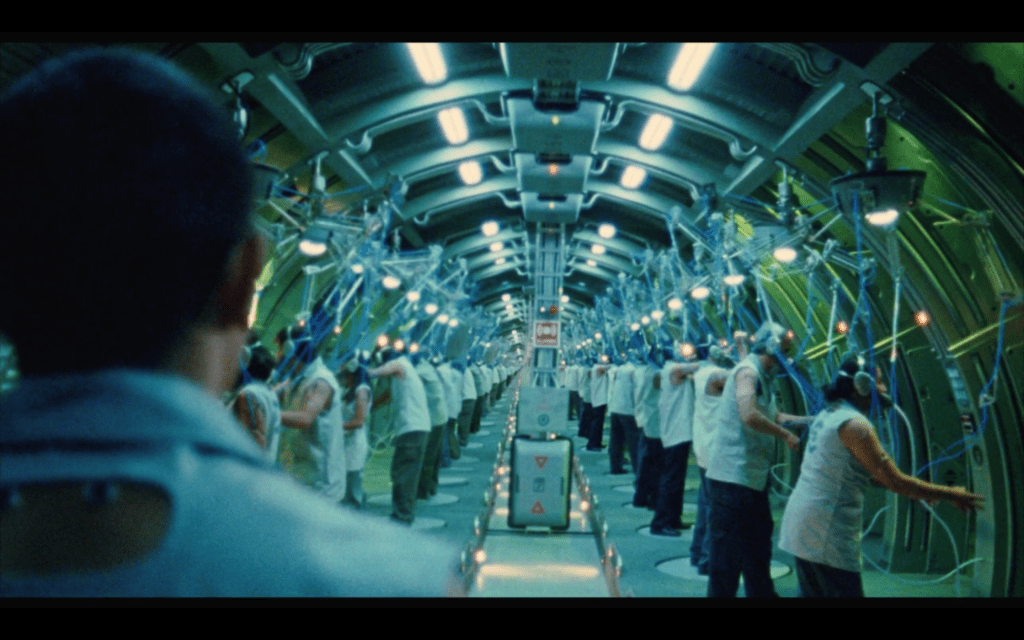
Sleep Dealer, Critical Race Theory and Ecocriticism
The film Sleep Dealer sheds a light on a huge global problem – Americans benefiting from the work of non-citizens. I feel that most Americans choose to turn a blind eye to the fact non-citizens are working and/or their working conditions because their cheap labor benefits Americans, the economy, and their wallets. This is the “out of sight, out of mind” I touched on earlier. There are tedious, labor-intensive, low-paying jobs needing to be done in the country and Americans fall under a few categories: (1) being blissfully unaware of the suffering of non-citizens doing the work (2) knowing non-citizens are doing the work but believing it is a necessary evil (3) feeling it is more humane for robots to do the work, not knowing it is non-citizens controlling the robots (4) not wanting non-citizens to work in the country and hiding behind the fact non-citizens control the robots. If you have more suggestions for categories or commentary on this, please write it in a comment below! The film combines ecocriticism, critical race theory, wealth theory (is this a thing? Please let me know what the correct term is) when it touches on poor Mexicans not having access to clean drinking water without a high fee.
I really enjoyed the film and I feel I am unable to accurately write about the film in a way that does it justice, so I urge you to watch the film.













 Caitlyn's Blog