Sleep Dealer, Critical Race Theory and Ecocriticism

Similarly to many films I have written about previously, Sleep Dealer is a film I have never seen before. It is an indie futuristic science fiction film released in 2008. The film showcases a dystopian world that takes the idea of “out of sight, out of mind” way too far.

Plot

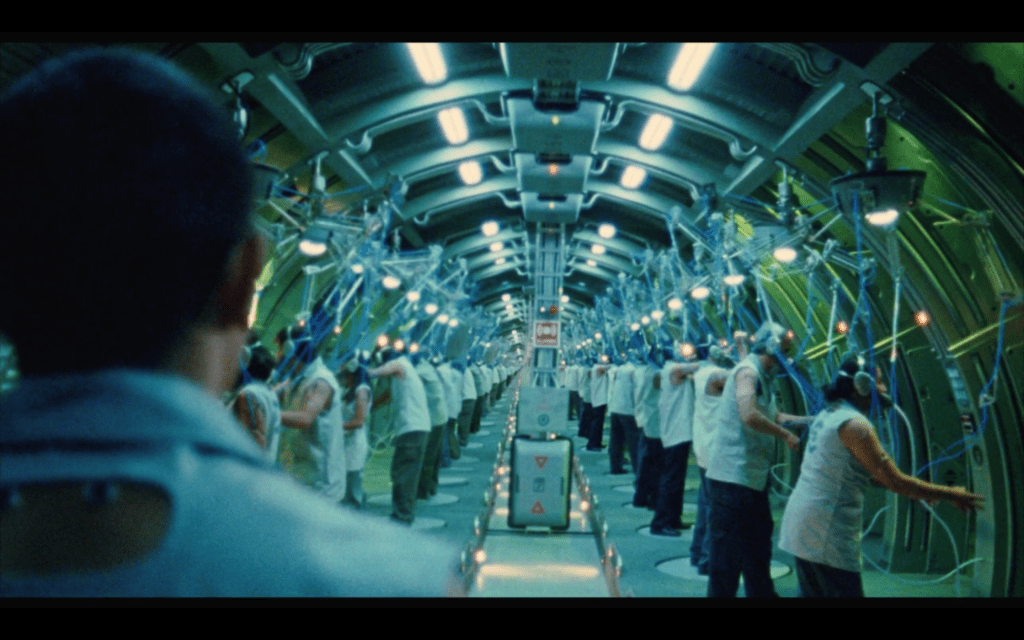
The main character is a Mexican man named Memo Cruz. Water in his home city used to be free and accessible until a water company came in and began charging resident $1 per gallon. Memo puts together a gadget to listen to people, which ultimately gets his family home targeted with a missile causing his father to die. Feeling guilty, Memo flees to another city and meets Luz, who has data ports on her arms. He talks briefly to her about his background and Luz sells this memory she took of him. Memo looks to have data ports put in his body, which Luz offers to do after Memo was mugged looking elsewhere. Memo begins working as a “sleep dealer” at a virtual sweatshop. This entails workers being connected to cables that control robots that have replaced immigrant workers. Luz gets paid to get more personal information about Memo in the form of another memory. The buyer is revealed to be Rudy, who killed Memo’s father. Luz, Memo, and Rudy sneak into Cybracero and have a drone attack the water company, allowing water to be free to residents once again. In the end, Rudy sells water for a living while Memo does manual farming.
Sleep Dealer, Critical Race Theory and Ecocriticism

The film Sleep Dealer sheds a light on a huge global problem – Americans benefiting from the work of non-citizens. I feel that most Americans choose to turn a blind eye to the fact non-citizens are working and/or their working conditions because their cheap labor benefits Americans, the economy, and their wallets. This is the “out of sight, out of mind” I touched on earlier. There are tedious, labor-intensive, low-paying jobs needing to be done in the country and Americans fall under a few categories: (1) being blissfully unaware of the suffering of non-citizens doing the work (2) knowing non-citizens are doing the work but believing it is a necessary evil (3) feeling it is more humane for robots to do the work, not knowing it is non-citizens controlling the robots (4) not wanting non-citizens to work in the country and hiding behind the fact non-citizens control the robots. If you have more suggestions for categories or commentary on this, please write it in a comment below! The film combines ecocriticism, critical race theory, wealth theory (is this a thing? Please let me know what the correct term is) when it touches on poor Mexicans not having access to clean drinking water without a high fee.

I really enjoyed the film and I feel I am unable to accurately write about the film in a way that does it justice, so I urge you to watch the film.

Critical Race Theory & Ecocriticism

No photo description available.

Media Summaries
Toward an Environmental Justice Ecocriticism” by T.V. Reed

In this article, Reed writes about issues he sees within the ecocriticism community. He points out a lack of diversity and the climate change movement being mostly white. While I agree with him on this, as a Native woman I feel Indigenous groups often do not get an invitation to sit at the table when they should be the first taken into consideration.

Earth Democracy Actions” by Vandana Shiva

Shiva does an excellent job in this article of making connections between social issues and climate issues. She also writes in a way that is easy to read but factual, connects to spirits but not any particular religion and draws on pathos but is not overly emotional. It was really balanced and written in a way to connect with everyone. Shiva writes that Earth Democracy is “both an ancient worldview and an emergent political movement for peace, justice and sustainability.” I really enjoyed this article’s list of 10 principles of Earth Democracy:

  1. All species, peoples, and cultures have intrinsic worth
  2. The earth community is a democracy of all life
  3. Diversity in nature and culture must be defended
  4. All beings have a natural right to sustenance
  5. Earth Democracy is based on living economies and economic democracy
  6. Living economics are built on local economies
  7. Earth democracy is living democracy
  8. Earth Democracy is based on living cultures
  9. Living cultures are life nourishing
  10. Earth Democracy globalizes peace, care, and compassion

Green is the New Black“, a | TEDxYale Talk by Shannon Prince

Shannon Price beautifully intertwines literature, poetry and statistics when talking about the overlap of race and climate. She talks about black Americans having far less green space than white Americans and black people living in areas more affected by climate change. I was disgusted to hear about black children dying of asthma at a rate 7 times higher than white kids. She importantly states that race, class and climate are connected and when one is bettered or worsened, the rest will be as well.

The Green New Deal vs. the Old Green Deals - CityLab

Critical Race Theory and Ecocriticism Intersectional Analysis

As a social worker, it is important to see the intersections of societal topics and how these topics affect the quality of lives for groups of people. Similar to how race, class and gender are connected, race and climate are also connected. Racist American policies such as redlining worked to ensure people of color were in poor areas that were more greatly impacted by climate change. This impact continues to today. “In the U.S., African Americans have greater exposure to toxins than white people for 13 out of 14 air pollutants. Hispanics have the highest exposure for 10 out of 14.” (True Climate Justice Is Impossible Without Racial And Economic Justice)

Ecofeminism in “Avatar”

Once again, this is a film I had never seen before this class. This class has really shown me how much of our beliefs and values as a society are shown through film and how much I am missing out simply because I do not watch a lot of films. Avatar is undoubtedly a wildly successful and beautiful film deserving of all its praise.

Zoe Saldana, who plays Neytiri

Plot

In the not so distant future, humans have exhausted Earth’s natural power resources and they see the Planet Pandora – and its supply of energy source Unobtanium – as a savior. Pandora is inhabited by the Na’vi, who are blue 10-foot tall blue-skinned human-like creatures. To scope out the new planet, humans – including main character Jake Sully –  take form as “avatars” and masquerade as the Na’vi. Jake is successful in seeking out sources of Unobtanium but ends up falling in love with Na’vi woman Neytiri. A battle ensues and ultimately leaves Jake in his avatar and humans without Unobtanium.

Critical Review

Something I find to be similar in many movies that have ecological themes is that nature has something valuable to humans – in this case unobtanium. It seems to me that humans only care about nature when there is either a pressing and immediate threat to their lives or there is potential for financial or power gain. In this and many medias, nature is a revenue generator that serves humans. I’m sure Jake’s perception of nature changes when he switches sides from humans to the Na’vi. The environment is a central player here and in a way, a character in and of itself. An important thought to remember when absorbing any type of media – especially those with nature as a main aspect – is that even when people don’t see it directly, media “influences human behavior with regard to the natural world” (Legler 227). Avatar  is indeed a film that makes powerful statements about the importance of caring for the Earth while also shining a light on the very real profit-driven values humans have. “The film Avatar is credited for its strong ecological message…At the same time, the film might also be read as the kind of tragic literature that mirrors…humanist values and ideals” (Waking Up From Avatar). 

“Ecofeminist thinkers draw on the concept of gender to analyse the relationships between humans and the natural world” (Wikipedia). Avatar, like most films that feature nature as a main component, has a female character that embodies nature while a male character embodies civilization. The concept of “mother Earth” is embedded deep within our brains, as evidenced by the Na’vi worshiping mother goddess Eywa and in the ways gender roles have been established within society as it relates to the environment. Within my tribe – the Yurok Tribe – men are traditionally hunters, the ones who take life and then sweat and pray to the creator and Earth for forgiveness and permission to continue taking for the sake of feeding the tribe. Women are traditionally the creators of life who grow and nurture children and plants and care for tribal members. In my opinion, Avatar has many similarities to this.

Miyazaki’s Nausicaa of the Valley of the Wind

I’ll be honest – I have no real interest in anime, manga or animated movies. It’s subconscious but I believe it’s because I find a lot of animation styles disturbing. I have tried watching My Neighbor Totoro and Castle in the Sky along with numerous American animated films and I could not get into most of them. With that being said, I did have some preconceived notions about Nausicaa of the Valley of the Wind but I tried to have an open mind.

Plot

A thousand years have passed since a war destroyed civilization and created the toxic jungle. The main character, Nausicaä, is the “savior” of the land. Battles ensue over a powerful embryo of a Giant Warrior, one of the lethal, gargantuan humanoid bioweapons that caused the initial war a thousand years ago. Princess Kushana wants to grow the embryo and use the create to destroy the toxic jungle. It is then discovered there are clean and healthy plants below the toxic jungle. Nausicaä ends up fulfilling her savior prophecy. It then cuts to a non-toxic healthy tree sprouting under the toxic jungle.

Ecocritical Analysis

Utilizing a critical lens like ecocriticism helps engage the brain while watching films, especially films one would not choose to watch on their own time. In the film, nature is shown through a toxic jungle and the non-toxic area underneath the jungle. Nature was changed overtime through human contact since the toxicity came from war. Animals are represented in the film through giant mutant insects and plants are represented through the toxic jungle and non-toxic plants that clean water. The film does claim that all plants and animals are bad, but that pollution causes strange things to happen to plants and animals. It is shown in the film that nature was oppressed in the past but is now reclaiming its territory and is being empowered through the non-toxic tree sprout that begins growing at the end of the film. This event reminds me of how plants will work their way through concrete and cement (pictured below). This film was made for children but has a deeper message about pollution and climate change, similar to WALL-E. I have to give props to this film because the animation was beautiful, the message was important and it was beautifully made. Even I, an animated film hater, was impressed.

Okja and Ecocriticism

Similar to many of my classmates, I have never watched or heard of the movie Okja. To be fair, though, I don’t watch tv or movies often so I am likely not the studio’s target demographic. I like to read plots of movies before I see them. I know, I know – I ruin films for myself, my boyfriend already tells me so. However, I find that doing this helps me prepare for the gruesome scenes that turned my stomach and the heartwrenching scenes that brought tears to my eyes. I’ll admit I’m a softie when it comes to animals – I’ve been vegetarian and plant-based for 7 years, a choice I made days before turning 16.

Movie Summary

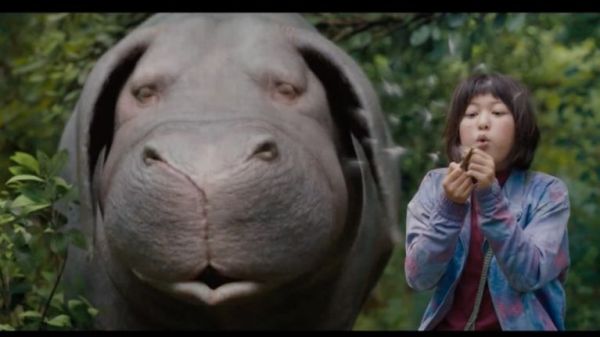
A young girl named Mija, who lives in South Korea, has been taking care of her pet of sorts, Okja. Okja is a large pig-like animal and the large corporation Mirando sees Okja’s species as being a great source of meat that will be more environmentally friendly than traditional factory-farmed meat. The company takes Okja back to New York and exploits her as a tool in their bigger plan of maximizes meat and maximizing profits. Mija shows a lot of bravery for a girl her age and she fights ruthlessly to get Okja back. Right before Okja is about to be slaughtered, Mija saves Okja with the power of a photograph showing them together from a young age. The movie ends with a group of anti-Mirando organizers who plan to disrupt a large important company meeting.

How are nature and culture represented in this film?

Nature and culture are represented through the greed of the meat industry and overpopulation of people, which is increasing the meat need. Culture caused overpopulation and nature is being exploited in order to satisfy the need. This reminds me of the common saying “If animals aren’t meant to be eaten, why are they made of meat?” This is seeing animals from an exploitive view instead of a harmonious point of view in which humans, animals and all the rest of the Earth all benefit from each other.

How do we see issues of environmental disasters and crises reflected in “Okja”? How are ecoactivists portrayed? How are corporations portrayed? Where does middle ground exist?

The amount of blood pouring out of the animal while it is being cut open surely correlates to mass amounts of pollution from slaughterhouses, which largely contribute to climate change. Ecoactivists are portrayed similarly to the way vegan and vegetarian protestors are portrayed – as extremists who want to ruin everything for everyone. The corporations portrayed themselves as environmentally conscious, wanting to help feed people and trustworthy. Middle ground exists where food is raised locally and without harm. Western culture needs to learn from the tribes whose land we are on and learn how the tribes have continued to sustain the land and food for longer than we can comprehend.

How are animals represented in this film and what is their relationship to humans?

To Mija, Okja is a friend. To the people who work for the meat industry though, Okja is simply meat and profit.

Okja and Veganism

Apparently Okja filmmaker Bong Joon Ho became vegan while conducting research for the film. The big question is, is he still vegan? It is a large issue within vegan culture for people to become vegan or vegetarian but quit shortly after starting. I’m curious, did this movie impact your eating at all?

Intro to Ecocriticism

Ecocriticism

As a future social worker, social justice is a key component of my field. One lesser known component of social justice is environmental justice wherein the environment and its impact on people is studied and social workers aim to make that impact equally distributed. Ecocriticism uses that environmental justice lens to analyze media. Purdue OWL describes ecocriticism as “believing that ‘human culture is connected to the physical world, affecting it and affected by it’” (Glotfelty qtd. In Purdue OWL). In the Gerrad article, it is also described as  “the study of the relationship between literature and the physical environment” (Glotfelty qtd. in Gerrard). However, more media than solely literature is analyzed today.

Snickers Ad

This was my first time watching the “#SnickersFixtheWorld” advertisement. I must say, I dislike the ad and it did not make me want to buy a Snickers. The singing is so obnoxious and the premise makes no sense. Just like the Peloton ad, I found the Snickers ad unfunny, annoying and unrelatable. It seems like most mainstream marketing just doesn’t do the trick for me.

For a little backstory: the premise for the ad is based off old Snickers ads where people become themselves again after eating a Snickers. This new Snickers ad is related to the environment in that it features people digging an enormous hole in the ground in order to “fix the world by feeding it Snickers.” Nature is represented in the ad as a root of all human issues and somehow burying a giant Snickers bar will fix it all (it worked for people, so it’ll work for the entire plant, right? However, the “problems” pointed out in the ad are human problems, not ecological problems. Instead of feeding the earth a snickers, they should have fed all the humans Snickers. Additionally, all the issues named in the video are only issues to people in developed nations who are wealthy and privileged (e.g. many different types of milk and autocorrect messing up). Why not try to fix problems related to inequality instead of these 1st world problems?  If Snickers really cared, why not make an ad about how they’re giving back or donating to charity? I really don’t see the ad doing any good for the environment. If anything, it will only cause people to blame the earth for societal issues and use “nature” as a scapegoat. The earth itself is not to blame for our human and societal problems. LEAVE MOTHER EARTH ALONE.

Babbling about Babel

Film Summary

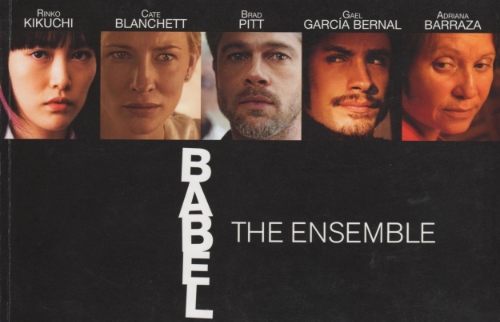
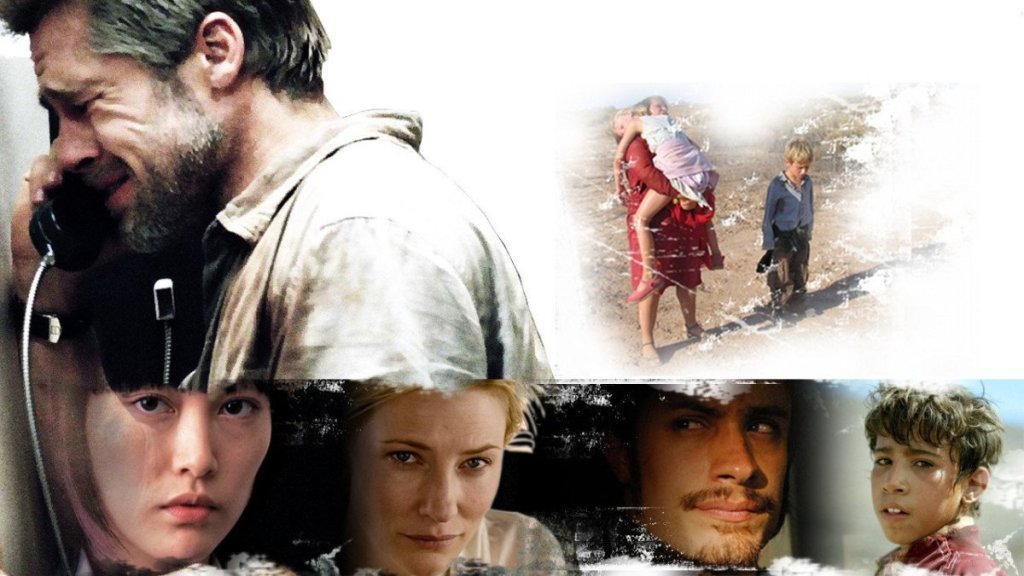
I, likely along with many of my classmates, have never heard of the movie Babel before. When I first read about the background of the film, I got excited because I am a big fan of movies with ensemble casts, especially when those movies have a  surprising connection between the main characters. Babel focuses on four different main characters. The beginning of the film takes place in Morocco, where two young boys, sons of a man named Hassan, are playing with his gun. They shoot at a bus and critically wound American citizen Susan, who is with her husband, Richard. It soon cuts to the United States, where Susan and Richard’s  nanny, Amelia, is faced with taking the children to Mexico for her son’s wedding, since no one else can watch the children. After being abandoned with the children in the desert with no food or water, Amelia decides to turn herself in to border patrol in order to save the children’s lives, which leads to her deportation from the United States. Meanwhile Richard and Susan are vacationing because they recently lost their third child and have not had the strongest marriage or communication with each other lately. In Japan, Chieko is a Deaf teenager whose mother recently commited suicide; all she wants is love and attention. It is revealed that Chieko’s father, Yasujiro, gifted Hassan the gun during his hunting trip in Morocco, presumably the same gun Chieko’s mother killed herself with.

Critical Analysis

For an insight into critical analysis of the movie, I looked to “Cultural and Urban Transformation: From ‘Babel’ to ‘Ecumenopolis’” By Dr. Müberra Yuksel. One of the points of the film Yuksel writes about that is very important when it comes to critical analysis is researching the background of the movie and where the title or headline comes from. Watching the film, I was curious as to why the film was named Babel. According to Lexico, Babel means “a confused noise made by a number of voices.” I thought that the film was named Babel simply because of the language barriers shown in the film and the fact communication is such a key issue in the film. However, Yuksel’s research goes beyond this and they write about the film’s title being derived from the story of Tower of Babel. In this story, “God punishes mankind for the arrogance and pride in attempting to build a tower leading to the Heaven.” As a result of this, God separated people into groups with differing values, cultures and languages. In this context, Babel does not refer to babbling, which was my original theory. This shows how important that deep research is for a full understanding of a media piece, which is needed for a full critique.

Many of my classmates and I felt saddened by the film. I mean, how could we not feel that way? With loss, grief, emptiness and disconnection, the film makes us feel that way. Despite this, Yuksel writes that the movie’s director did not intend for the film to only be sad, but to be hopeful at the end. This is shown through the translator being by the American couple’s side despite potentially losing his job and through the Japanese officer not taking advantage of Chieko, but seeing she is merely hungry for love. This is the director’s way of showing that we are all more connected and capable of communication than we think.

Black Panther and Critical Race Theory

Summary and Response Black Panther

I’ll be honest – I hadn’t watched Black Panther before now. I don’t find superhero movies appealing; and honestly, I don’t watch many movies in general. I am happy this movie exists and I hope that there will be more movies with casts consisting mainly of people from underrepresented groups. However, I don’t feel it is my place to share my personal experience with this movie or how this movie is affecting society – I feel that I need to keep that space open for Black people. With that being said, I would love to see a superhero led by a Native American cast – I’m waiting, Marvel and DC.

To summarize the film: Five African tribes fight over a meteorite containing Vibranium, a highly valuable material. A warrior ingests a “heart-shaped herb,” gains superpowers and becomes the first “Black Panther”. The nation of Wakanda is formed from all but one tribe and Wakandans use the Vibranium to advance their technology while also posing as a Third World country. T’Challa tries to claim the throne after the king dies but Killmonger appears and battles T’Challa for it. In the end, Killmonger dies, T’Challa is king and Wakanda reveals itself as the advanced nation it is to the rest of the world.

Cultural Representation

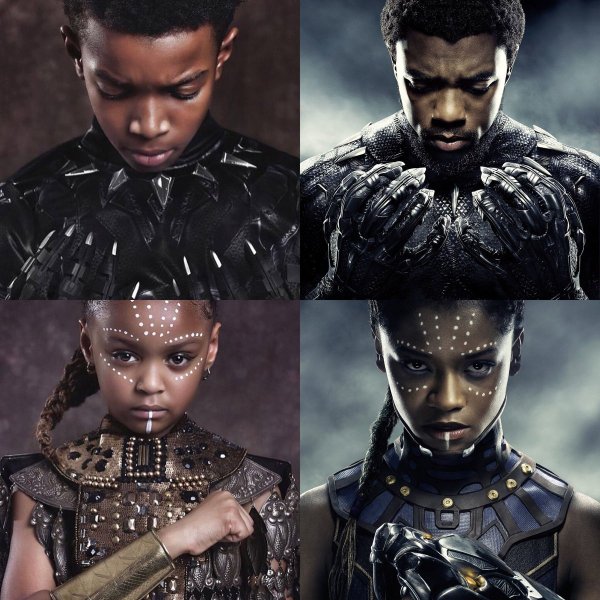
For many Black people, Black Panther is seen as a rare gem of representation among a sea of whiteness. After all, a movie having a majority Black cast is a rare occurrence. Carvell Wallace of the New York Times wrote an article titled “Why ‘Black Panther’ Is a Defining Moment for Black America” and included a quote from Jamie Broadnax, the founder of Black Girl Nerds. Broadnax reaffirms how monumental it is to have a film with a majority Black cast. She is quoted as saying: “It’s the first time in a very long time that we’re seeing a film with centered black people, where we have a lot of agency.” Time Magazine writer Jamil Smith writes in his article “The Revolutionary Power Of Black Panther” that “Making movies about Black lives is part of showing that they matter.” The image I’ve chosen for this blog post is of two young children dressed as characters from Black Panther. In my opinion, this image showcases the impact the film has had on African American youth, giving them more representation and an actual superhero they can look up to.

One of the other reasons the movie earned praise from Black critics is because it showcased Blackness in a fresh light. Wallace also wrote about another quote from Broadnax: “These characters, she notes, ‘are rulers of a kingdom, inventors and creators of advanced technology. We’re not dealing with black pain, and black suffering, and black poverty’ – the usual topics of acclaimed movies about the black experience.”

Christopher Lebron, writer from Boston Review, wrote an article titled “‘Black Panther’ Is Not the Movie We Deserve.” In this article, he expresses that the movie is not extremist enough in its views and does too little too late. The bad guy is the black American who has rightly identified white supremacy as the reigning threat to black well-being; the bad guy is the one who thinks Wakanda is being selfish in its secret liberation; the bad guy is the one who will no longer stand for patience and moderation—he thinks liberation is many, many decades overdue. And the black hero snuffs him out.” He goes on to say “My president already despises me.” I understand where Lebron is coming from here, but a single movie will not fix the entirety of race issues in the U.S.A. For instance, the 2017 movie Girls Trip is a chick flick comedy that was widely mocked on social media yet was incredibly successful at the box office and has a score of 91% fresh on Rotten Tomatoes. The cause of this? The four main characters are Black women and the movie is about them having a good time together. Does every movie starring a majority Black cast have to be about social justice? In my opinion, no. However, by there being more movies starring a majority Black cast, it is helping level the playing field and increase social justice.

Another idea that was brought up around Black Panther was whether critics of color are being given enough opportunity. Elizabeth Méndez Berry wrote for Hyperallergic an article called Why Cultural Critics of Color Matter.” Berry writes: “For communities that have been historically shut out of that process, that power is pivotal. It’s the difference between being spoken about and being the authority on your own experience.” This is an extremely important point and what I was touching on in the beginning of this blog post. Make room for the population at hand to speak for themselves instead of being spoken over/for.

Critical Race Theory & Casting White People to Play POC

Critical Race Theory

Critical Race Theory (CRT) is a framework of theory that examines race and racism and how they are expressed within society. According to Purdue OWL, CRT scholars “attempt to understand how victims of systemic racism are affected by cultural perceptions of race and how they are able to represent themselves to counter prejudice” (OWL). In my opinion, the second part of that sentence is tremendously important because to many people, CRT would seem like self-victimization. It is important to both recognize systems of oppression and also recognize how to fight back against them. In my last blog post, I wrote about how critical race theory is commonly used in social work (my major), so I pulled in a quote from a social work article to show the connection between the two. The article states that CRT “can provide a theoretical approach to social work practice that allows us to understand that the issues that a client presents have less to do with the client themselves and just as much, if not more, to do with institutions and systems.” In social work, CRT helps social workers understand the impact systems and have upon a person based on race. It also seems that while CRT has an agreed upon definition, how to represent it and use it has no consensus. Derrick Bell writes: “The answers to what is critical race theory are fairly uniform and quite extensive. As to what critical race theory ought to be, the answers are far from uniform…” However, I imagine this happens among all theoretical frameworks and not just CRT.

Casting White Actors to Play POC

I grew up watching Spy Kids but I never heard about an animated Spy Kids movie until now. I don’t know how I missed this controversy, I guess it’s because no media outlets really talked about it except TMZ. I also think that no one really heard about the movie, so no one heard about the controversy. I hate to agree with TMZ but they make really good points in their video interview and article about Travis Turner, a white man who voiced a black male character for the Spy Kids animated movie. After TMZ asked Turner about possibly receiving backlash for his role, he dug himself into a deeper grave by saying “If they want they can say whatever. I actually come from an urban background. I lived in motels. What I’m trying to say, I relate to the urban community.” YIKES. Living in an urban area and living in motels makes it okay for him to voice a black character? I’m genuinely curious as to whether this actor aligns himself with being black because of how he was raised. TMZ writes “But it gets worse, he also said he worked with Snoop Dog and ‘sponsored Black kids.’ Oh, and he grew up all Chris Rock and Chris Tucker. Yep, Travis has all things Black figured out.” Travis, my man, why do you have to make me agree with TMZ? Do you know how low you have to go for me to side with TMZ? Being friends with black people does not grant you certain rights or privileges or a “I’m not racist” card. I’m curious, does Turner also think it’s okay for him to say the n-word since he grew up in an urban community and has black friends? Additionally, TMZ makes a good point, which is where my mind had gone before I even saw the video: Why did the studio hire the actor? The blame shouldn’t just be on the actor, but also the studio, which is Netflix. The problem with casting a white actor to play a black character is that it takes away opportunities from actually black actors (note: by “actually black”, I am excluding white guys who have simply lived out of motels). It seems Netflix was woke enough to have a black animated character, but not woke enough to cast a black actor. It seems like Netflix was just trying to thoughtlessly crowd please. Now that’s what I call fake wokeness.

https://www.tmz.com/videos/0-38rf6nlt/

Intro to Me, Cultural Criticism and Awful Ads *cough cough* Peloton *cough*

A Short Introduction to Me via My Media Influences

A few of the books that have contributed to my sense of self are Race, Class, and Gender in the United States, Black Girl Dangerous and The New Jim Crow. Movies that have contributed to my sense of self are “The Aristocats,” “The Iron Giant,” “Short Term 12,” “Fed Up,” “Food, Inc,” and “Unnatural Causes: Is Inequality Making Us Sick?” There have been countless YouTube videos I don’t remember that have contributed to my sense of self. ASMR is a popular category of videos on YouTube that have contributed to my sense of self in that they helped me realize what sounds make me relax and the effects different sounds have on me. If I were blogging as a mass media icon, I might be similar to actress Susan Sarandon, Dr. Jill Stein or writer Mia McKenzie because my blogs would focus on social issues.

Cultural Criticism

Critical Race Theory and Gender/Queer Studies are suitable for an analysis of the books listed in the above paragraph. Marxist Criticism and Moral Criticism may also be suitable for the books as well as some of the other media listed. Critical Race theory is something we talk about in social work as well as Gender/Queer Studies and Critical Disability Theory, so those three fascinate me. Structuralism/Semiotics is the least interesting to me because it is very complex and seems to deal with codes and patterns, which I struggle with (I can’t even clap on beat). I would love to learn more about Reader-Response Criticism because the idea that a piece of media’s meaning comes from the consumer’s perspective is interesting. 

Awful Ads

When the Peloton ad “The Gift That Gives Back” went viral in December 2019, it was heavily criticized for being sexist, and I understand where the criticism came from. Giving an exercise bike for a gift is like gifting someone acne face wash, deodorant or a razor – it’s a “gift” with an underlying jab of you aren’t the way I want you to be so use this and fix it. Unless these things were specifically asked for, gifting these things is inappropriate. The ad does not specify whether she asked for the bike or not but it does not seem like she asked for it to me due to her reaction upon seeing it. Scott Mautz of Inc.com wrote an article explaining that he sees the ad as sexist because of the way the woman is portrayed. He writes: “She comes across as unsure, timid, fearful, and needing approval.” Her husband gave her the gift and she is using it to please him – this is either because she didn’t want to seem ungrateful (the same way your mom made you wear that awful sweater your great aunt made for you) or because she took it as him telling her she needs more exercise. I also understand the backlash to the criticism – often times people are seen as being too sensitive nowadays and that the Peloton ad is just that – an ad. Despite me seeing the sexism in the ad, what hit me first is that it’s an awful ad. Having the woman film herself was a desperate attempt to connect with young adults. The ad is like an awful ad ice cream with swirls of sexism mixed in. Peloton stock plummeted after the ad. Oops! Their loss was Ryan Reynolds’ gain with his swift efforts to recruit the actress for an ad for his gin brand Aviation. It was clever – didn’t shove the product down the viewers’ throats, and didn’t try too hard to be relevant while also being on-trend. Smart move, Ryan.

Monica Ruiz, the actress featured in the infamous Peloton ad (left) looks uncomfortable and unsure. The Aviation ad (right) was meant to be a follow up/parody of the Peloton as wherein she appears to be traumatized from the Pelton ad.

Blog at WordPress.com.

Up ↑

Design a site like this with WordPress.com
Get started